Google AI Max Reporting: What Advertisers Need to Know in 2026
Introduction
Google Ads is moving further toward AI-powered advertising, and Google AI Max is a major part of that shift. AI Max is not a separate campaign type; it is an optimization layer that can be activated within existing Search campaigns. It uses AI and real-time signals to improve search-term matching, ad assets, landing-page selection, and campaign performance.
The move toward Google AI Max for Search reflects how search advertising is becoming more dynamic. Instead of relying only on manually selected keywords and fixed ad combinations, AI Max can use broad-match and keywordless technology to find relevant search opportunities that advertisers may not have anticipated. It can also use text customization to generate additional headlines and descriptions based on campaign context, including landing pages, existing ads, and keywords.
For advertisers looking at Google Ads AI Max 2026, the change is particularly relevant because Google began automatic upgrades for eligible campaigns using campaign-level broad match and text customization in September 2026. Google has also moved the automatic upgrade timeline for Dynamic Search Ads to February 2027, giving advertisers more time for that transition.
Another important development is reporting. Google announced on September 23, 2026, that it is introducing a new AI Max reporting feature designed to give advertisers a unified view of the Search ads journey—from the search term that triggered the ad, to the creative asset shown, to the landing page where the user arrived. Google says more details about availability will be shared later in 2026.
For AI Max campaign management, advertisers should therefore focus not only on automation but also on measurement and control. Google provides reporting for search terms, keywords, assets, and landing pages, while giving advertisers controls such as brand settings and URL inclusions or exclusions. Google also reports that advertisers activating AI Max have typically seen 14% more conversions or conversion value at a similar CPA or ROAS, based on its internal 2025 data for non-Retail advertisers. This figure is an average reported by Google, not a guaranteed result for every campaign.
In 2026, Google AI Max represents a broader move from traditional keyword management toward AI-assisted search intent, creative optimization, and campaign automation.
(Resources :https://www.marketingdive.com/)
What Is Google AI Max for Search?
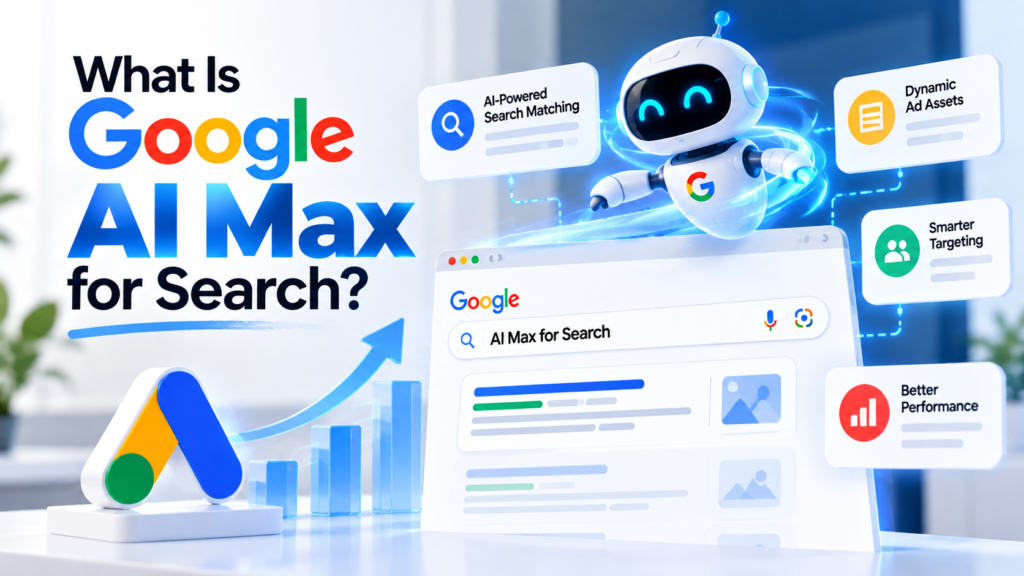
Google AI Max for Search is a suite of AI-powered targeting and creative features that works inside existing Google Search campaigns. It is not a separate campaign type. Instead, it acts as an optimization layer that uses real-time signals to improve how ads find relevant searches, create ad messaging, and direct users to relevant landing pages.
Simple Definition
In simple terms, Google AI Max helps advertisers move beyond relying only on manually selected keywords. It can use broad-match, asset-based and keywordless technology to identify relevant search queries that may not have been covered by the original keyword list. Google also provides controls for brand settings, locations of interest, and URL inclusions or exclusions.
How AI Max Works
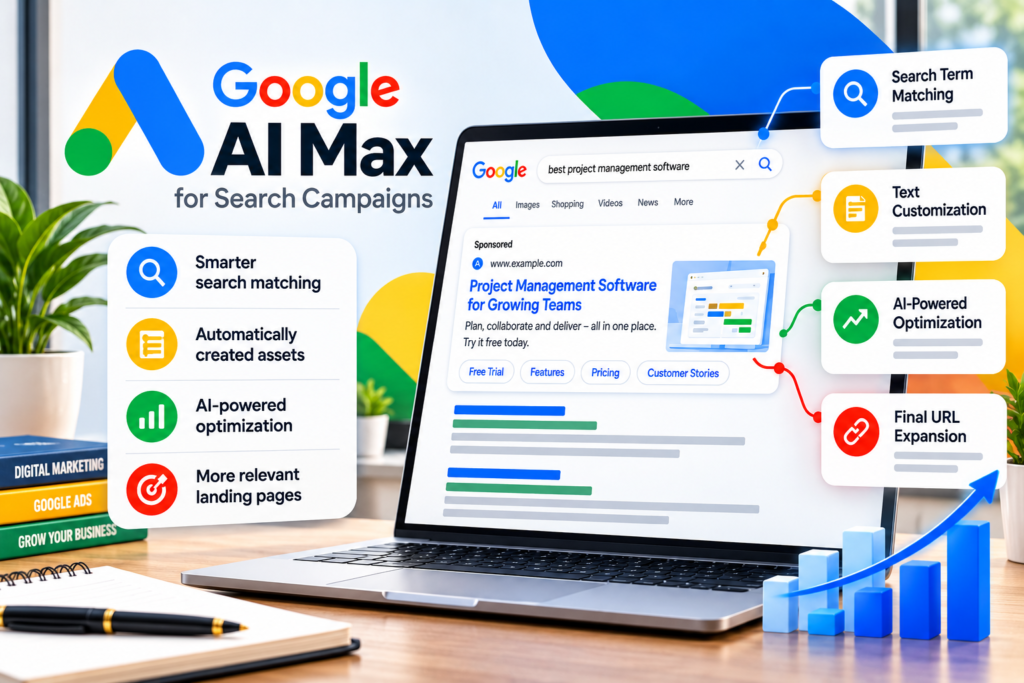
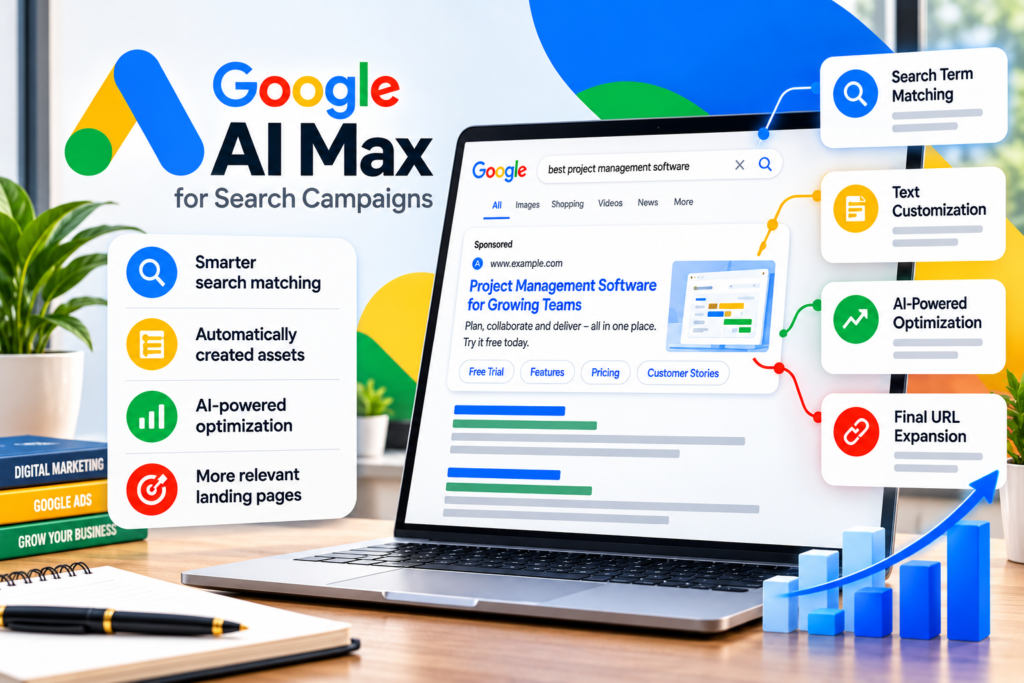
An AI Max campaign combines several AI-powered features. Search term matching expands reach by using existing keywords, creative assets and website URLs to identify relevant queries. Text customization can create additional headlines and descriptions based on the advertiser’s existing ads, landing pages and keywords. Final URL Expansion can send a user to a more relevant page on the website when Google determines that it better matches the search intent.
Google has also added more detailed reporting. Advertisers can see AI Max match types in Search terms reports, performance information for optimized assets, and which landing pages were selected by AI Max.
How It Differs From Traditional Search Campaigns
Traditional Search campaigns can depend more heavily on manually selected keywords, advertiser-written ad assets and predefined landing pages. With Google Search AI Max, more of these decisions can be assisted by Google’s AI using real-time signals.
However, AI Max does not remove advertiser control completely. Google still provides controls for brands, locations and URLs, allowing advertisers to set boundaries while using greater automation.
For Google Ads AI Max, the key difference is therefore not a replacement of Search campaigns, but a shift toward AI-assisted targeting, creative optimization and landing-page selection within the existing Search campaign structure.
Why Did Google Introduce AI Max?
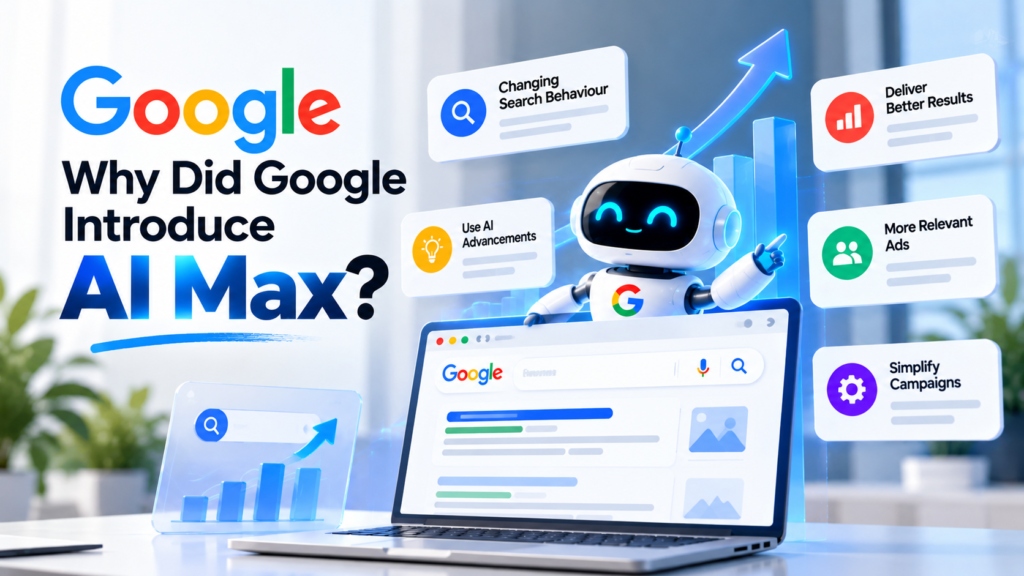
Search behavior is changing quickly, and Google is responding by making advertising more AI-driven. Google AI Max was introduced to help Search campaigns handle a world where users are asking longer, more detailed and less predictable questions. Google says its AI Mode has surpassed 1 billion monthly active users globally, while AI Mode queries have more than doubled every quarter since launch. This shift means advertisers cannot realistically predict every relevant search with a manually managed keyword list.
AI-Driven Search Behavior
Traditional Search advertising was built around the idea that advertisers could identify important keywords and create ads around them. But users are increasingly searching in a more conversational and exploratory way. Google says people are asking more complex questions and using multimodal inputs such as images. Google AI Max is designed to respond to this changing behavior by using real-time signals to understand intent and discover relevant opportunities beyond an advertiser’s original keyword setup.
Better Matching Between Searches and Ads
One of the main reasons for introducing AI Max Google Ads is to improve the connection between what someone searches for and the ad they see. AI Max’s Search Term Matching can use broad match, asset-based and landing-page-based technology to find relevant queries. Its Text Customization feature can also create additional headlines and descriptions using information from existing ads, landing pages and keywords. This allows Google AI Max for Search to adapt messaging to the context of an individual search instead of relying only on fixed ad variations.
Automation in Targeting, Creatives and Optimization
Automation is another major reason behind Google Ads AI Max 2026. AI Max combines search-term matching, text customization and Final URL Expansion so Google can assist with targeting, ad creation and landing-page selection. Final URL Expansion can direct users to a more relevant page when Google determines that it better matches the search intent.
Google says that campaigns using the full AI Max feature suite have seen an average of 7% more conversions or conversion value at a similar CPA/ROAS compared with using Search Term Matching alone, based on Google’s internal data. This is Google’s reported average, not a guaranteed outcome for every AI Max campaign.
Overall, Google Search AI Max reflects Google’s broader move from simple keyword matching toward AI-assisted understanding of search intent. The goal is to help advertisers reach relevant customers, adapt creative content and automate more campaign decisions while retaining controls over important campaign settings.
Lets expore this blog with marketingwithaalok
How Does Google AI Max Work?
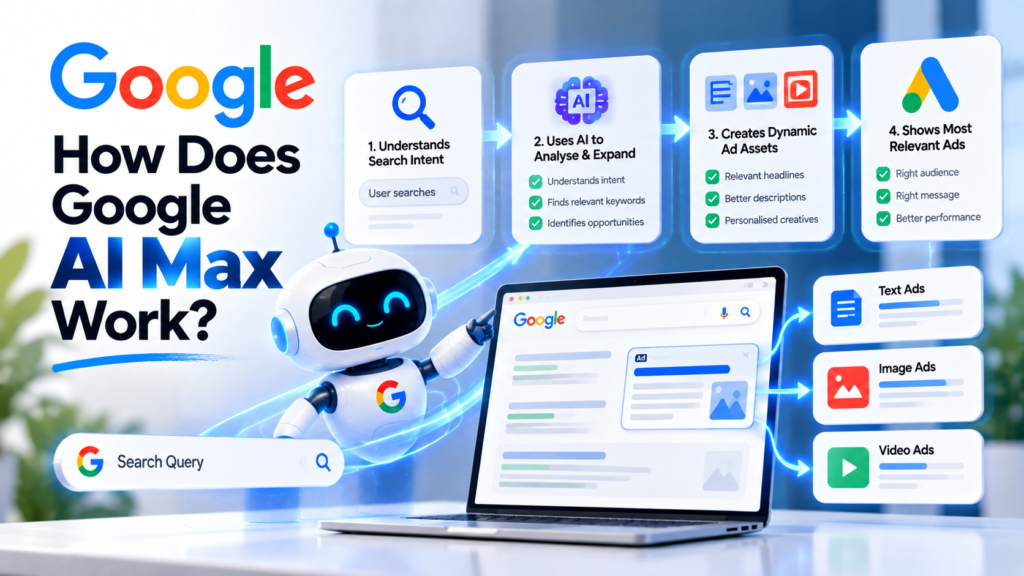
Google AI Max works as an optimization layer within existing Search campaigns. It combines AI-powered search-term matching, asset optimization and landing-page selection to help Google connect ads with relevant user intent. The main components include Search Term Matching, Text Customization and Final URL Expansion.
Search Term Matching
Search Term Matching helps an AI Max campaign discover relevant queries beyond the advertiser’s existing keyword list. Google uses broad-match, asset-based and keywordless technology, along with signals from the campaign’s keywords, creatives and URLs, to identify additional searches that may be relevant. This can help capture queries and conversions that traditional keyword coverage might miss.
Automatically Created Assets
Google now calls this feature Text Customization; it was formerly known as Automatically Created Assets. It can generate additional headlines and descriptions using information from the advertiser’s domain, landing pages, existing ads and ad-group keywords. Google says the generated assets are intended to make the ad message more relevant to the user’s specific search.
For AI Max Google Ads, this means advertisers can provide core messaging while Google’s AI creates additional variations for different search contexts.
Keyword & Broad Match Integration
AI Max expands traditional keyword-based targeting by combining existing keywords with broader and keywordless matching technology. Instead of requiring advertisers to anticipate every variation of a query, Google can use multiple signals to identify relevant searches.
This does not mean keywords disappear. Existing keywords remain part of the campaign’s inputs, while AI Max adds additional ways to discover relevant search opportunities.
AI-Powered Optimization
The broader Google Search AI Max system uses real-time signals to optimize targeting and creative delivery. Google describes AI Max as a continuous optimization layer designed to refine these decisions with less manual effort. Advertisers can still use controls such as brand settings, URL inclusions and exclusions, and search-term matching controls.
Landing Page & Conversion Signals
Final URL Expansion can send a visitor to a more relevant page on the advertiser’s website when Google predicts that the page better matches the search intent. It only selects URLs that are relevant to the query and themed to the ad group.
Conversion-based Smart Bidding strategies are important for AI Max features such as search-term matching, Text Customization and Final URL Expansion to function effectively. This means accurate conversion tracking remains an important part of an AI Max campaign setup.
Overall, Google AI Max combines targeting, creative generation and landing-page optimization into a more automated Search advertising workflow while still giving advertisers controls over important campaign boundaries.
Google AI Max vs Traditional Search Campaigns
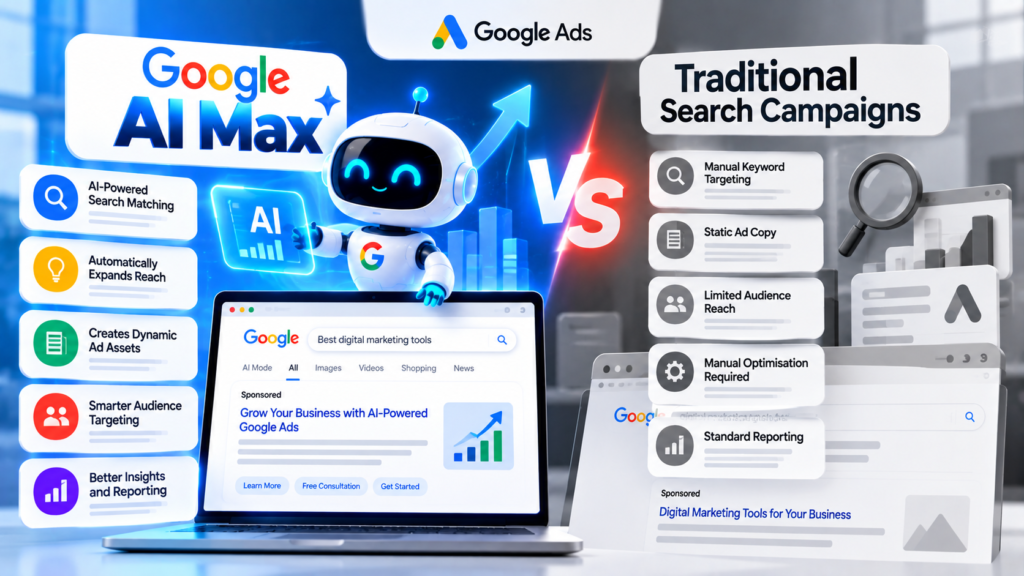
The main difference between a traditional Search campaign and Google AI Max is the level of AI assistance available for targeting, ad messaging, and landing-page selection. AI Max works within existing Search campaigns rather than replacing them with a completely separate campaign type.
| Feature | Traditional Search | Google AI Max |
| Keyword targeting | More dependent on advertiser-selected keywords | AI-assisted search-term matching can use broad match, asset-based and landing-page-based signals |
| Ad assets | Advertiser provides and manages responsive search ad assets | Text customization can generate additional headlines and descriptions using campaign and website context |
| Search matching | Primarily based on the campaign’s keyword setup and selected matching options | Broader AI-assisted matching can identify additional relevant queries |
| Landing pages | Advertiser generally specifies the landing page | Final URL Expansion can select a more relevant page based on the user’s query |
| Optimization | Manual management plus automated bidding | Greater AI-driven automation across targeting, assets and landing-page selection |
With AI Max Google Ads, the advertiser still maintains important controls, but Google can take a larger role in determining which searches, messages, and landing pages are most relevant. Search Term Matching, Text Customization, and Final URL Expansion are the core features behind this approach.
One important distinction is that AI Max does not simply remove keywords. Existing keywords remain part of the campaign, while AI Max can add broader ways to discover relevant searches. Similarly, generated text works alongside advertiser-provided assets rather than completely replacing them.
For advertisers comparing a traditional setup with an AI Max campaign, the practical shift is from mainly manual control toward a hybrid model: advertiser-defined goals and boundaries combined with more AI-assisted optimization.
What Changed in September 2026?
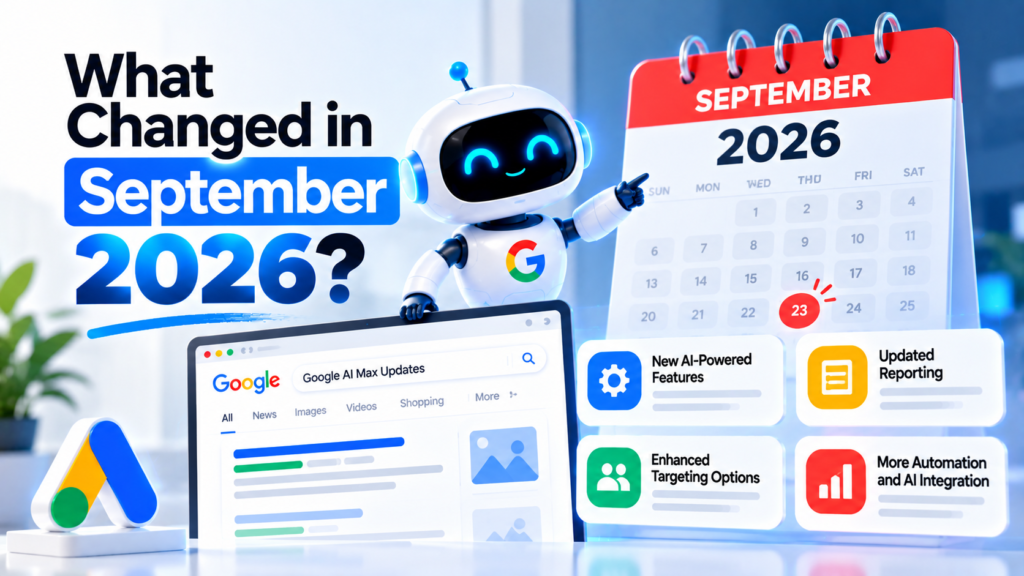
September 2026 marked an important transition in Google Ads as Google AI Max moved further into the standard Search campaign experience. Google announced that eligible Search campaigns using certain legacy AI-powered settings would be automatically upgraded to AI Max, with the aim of bringing targeting, creative optimization and reporting into one more integrated system. Google expected these September upgrades to be completed by the end of the month.
Which Campaign Features Are Being Transitioned?
The September 2026 transition primarily affects three existing Search features: campaign-level broad match, automatically created assets (now called Text Customization), and certain brand settings. Campaigns using campaign-level broad match are being upgraded to AI Max with Search Term Matching, while campaigns using automatically created assets are moving to AI Max with Text Customization. Google explains that these features are now managed within the broader AI Max framework rather than as separate legacy settings.
The transition for Dynamic Search Ads (DSA) is different. Google originally planned a September migration, but later extended the automatic DSA upgrade timeline to February 2027 to give advertisers more time to prepare.
What Advertisers Need to Check
For advertisers managing a Google AI Max campaign, the first step is to review which legacy features are currently active in each Search campaign. Check whether campaign-level broad match, Text Customization/automatically created assets, or relevant brand settings are enabled, and understand how those settings will map into AI Max.
Advertisers should also review conversion tracking, keywords, ad assets, landing pages and URL controls before and after the transition. This is particularly important because AI Max can use broader search-term matching, generate customized ad text and select relevant landing pages through Final URL Expansion.
Google also provides AI Max reporting covering search terms, keywords, assets and landing pages. A new unified reporting view announced on September 23, 2026 is designed to connect the search term, creative asset and landing page within a single customer journey. Google said additional availability details would be provided later in 2026.
The key point for Google Ads AI Max 2026 is that advertisers should treat September as a transition period: review existing settings, verify tracking and campaign controls, and monitor performance rather than assuming the upgrade will produce identical results for every campaign.
Benefits of Google AI Max
One of the main advantages of Google AI Max is that it helps Search campaigns move beyond a narrowly defined keyword list. By combining broad match, asset-based targeting and keywordless technology, AI Max can identify additional relevant queries that an advertiser may not have
specifically added as keywords. Google describes this as a way to find previously untapped search opportunities while maintaining campaign controls.
More Search Opportunities
Traditional keyword planning can miss variations in how customers search. Google AI Max for Search uses signals from existing keywords, ad assets and website URLs to understand search intent and discover additional relevant queries. This can potentially help advertisers reach users at new stages of the search journey without manually creating every keyword variation.
Automated Optimization
Another benefit of an AI Max campaign is greater automation across targeting and ad delivery. AI Max combines Search Term Matching, Text Customization and Final URL Expansion to help Google adjust targeting, messaging and landing-page selection based on context. Advertisers can still maintain controls over areas such as brands and URLs, so the system is not simply a fully uncontrolled automation process.
Additional Ad Variations
AI Max Google Ads also provides AI-assisted creative optimization. Text Customization can generate additional headlines and descriptions using information from an advertiser’s existing ads, keywords and landing pages. The purpose is to make ad messaging more relevant to different searches while keeping the campaign’s core information available to Google’s systems.
Better Use of Conversion Signals
AI Max works alongside Google’s conversion-focused bidding systems. Conversion data can help Google’s AI determine which opportunities are more valuable and which auctions are worth pursuing. This makes accurate conversion tracking especially important when using Google Ads AI Max 2026. Advertisers should measure meaningful business outcomes rather than relying only on clicks or impressions.
Google reports that advertisers activating AI Max in Search campaigns typically saw 14% more conversions or conversion value at a similar CPA or ROAS, based on Google’s internal 2025 data for non-Retail advertisers. Google also reports an average 7% uplift when the full AI Max feature suite is compared with Search Term Matching alone. These are Google’s reported averages, not guaranteed results for every campaign.
Potentially Broader Reach
Ultimately, Google Search AI Max is designed to help advertisers capture more relevant searches while adapting ads to changing user intent. For businesses with strong conversion tracking, useful landing pages and relevant creative assets, the broader reach and automation can create additional opportunities to test and scale Search advertising. The actual impact will vary by campaign, industry, budget and implementation.
Limitations & Things Advertisers Should Watch
While Google AI Max can add more automation to Search campaigns, advertisers should understand that greater automation also changes how some campaign decisions are made. AI Max can expand search matching, customize ad text, and select landing pages, so businesses need to review their campaigns carefully rather than assuming the system will always make the right decision. Google provides controls such as search-term matching settings, URL inclusions and exclusions, and brand controls, but some traditional controls can work differently when AI Max features are enabled.
Reduced Manual Control in Some Areas
One of the main considerations with an AI Max campaign is the reduced need—and in some cases reduced ability—for completely manual control. For example, when Final URL Expansion is enabled, Google can select a more relevant landing page based on the user’s search intent. Pinned Responsive Search Ad assets may also not be respected when a more relevant URL is selected. Advertisers can use URL exclusions or inclusions to guide the system, but they need to understand how these settings interact.
Manual CPC is another limitation. Google states that the full benefits of AI Max are limited when Manual CPC is used, and Search Term Matching does not work with Manual CPC. AI Max features such as search-term matching, Text Customization and Final URL Expansion are designed to work with conversion-based Smart Bidding strategies.
Need for Accurate Conversion Tracking
For Google Ads AI Max, conversion data is especially important. AI Max relies on automated bidding and real-time signals to optimize campaign performance. Google recommends conversion-based Smart Bidding for key AI Max features, which means poor tracking, missing conversions or incorrectly configured goals can provide the system with weak signals.
Before expanding automation, advertisers should therefore verify that their primary conversion actions, attribution settings, values and tracking implementations are working correctly.
Importance of High-Quality Creative Assets
AI Max can generate additional headlines and descriptions through Text Customization, using information from the advertiser’s domain, landing pages, existing ads and keywords. That makes the quality of the underlying website and advertiser-provided content important. Google says Text Customization uses both extractive techniques and generative AI to create additional assets relevant to search queries.
For Google AI Max for Search, advertisers should therefore provide clear messaging, accurate landing-page content and strong original assets. AI can optimize what is available, but it cannot replace a well-structured offer, relevant website content and reliable conversion data.
Overall, Google Search AI Max can reduce manual workload, but it should be treated as a system to monitor and guide—not something to switch on and ignore.
How to Prepare Your Google Ads Campaign for AI Max
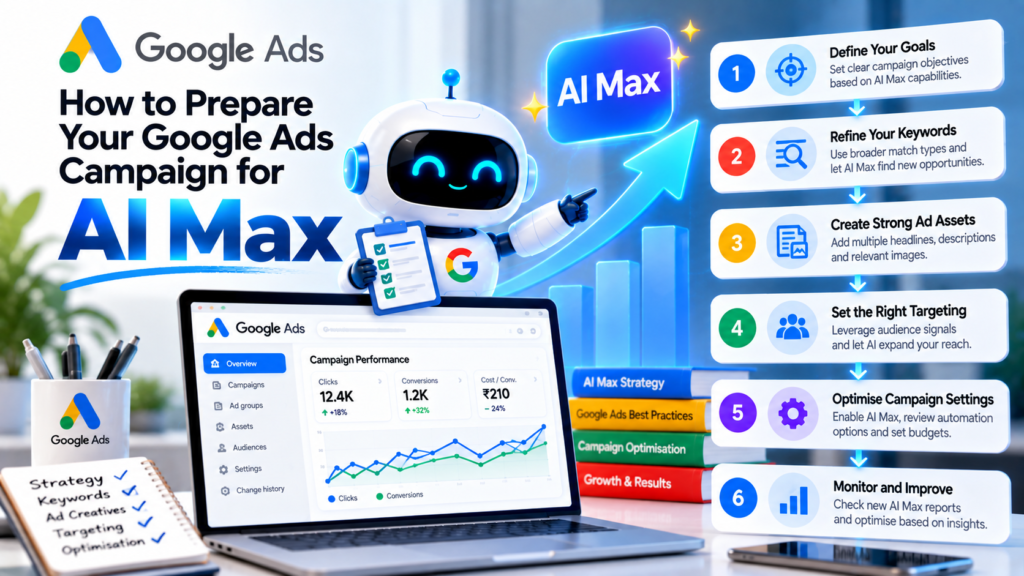
Before enabling Google AI Max, advertisers should treat the change as a campaign preparation exercise rather than simply switching on another feature. AI Max can expand search matching, customize ad assets, and select landing pages, so the quality of your conversion data, keywords, creative assets and website becomes more important. Google also recommends giving AI Max time to learn before making major changes; its reporting guidance recommends waiting at least two weeks after enabling AI Max before making changes such as adding negative keywords.
Check Conversion Tracking
Start by checking that your primary conversion actions are correctly configured. AI Max features such as search-term matching, Text Customization and Final URL Expansion are designed to work with conversion-based Smart Bidding. Make sure important actions such as leads, purchases or qualified enquiries are being recorded correctly before relying more heavily on automation.
Review Existing Keywords
Review your current keywords, match types and negative keywords before activating an AI Max campaign. Your existing keywords still provide important context, while AI Max can use broad-match and keywordless technology to discover additional relevant searches. After activation, use the Search terms report to understand where incremental traffic is coming from.
Improve Ad Assets
Strong advertiser-provided assets give Google’s systems better material to work with. Review your headlines, descriptions, offers and messaging before enabling Text Customization. Google says AI-generated text can draw from your domain, landing pages, existing ads, keywords and other campaign assets, so clear and accurate source content matters.
Check Landing Pages
Make sure important landing pages load properly, match the ad message and offer a clear path to conversion. This is particularly important with Final URL Expansion because AI Max can select a different relevant page based on the user’s query. Google also recommends checking tracking templates carefully because incompatible tracking parameters can cause problems with dynamically selected landing pages.
Review Audience Signals
For Search campaigns, focus less on treating audience signals as fixed targeting and more on reviewing the audience and conversion information already available in your account. Check customer lists, remarketing data and other relevant audience inputs where applicable, while remembering that AI Max also relies heavily on real-time search and campaign signals. Google provides controls such as brand settings, locations of interest, and URL inclusions or exclusions to help guide the system.
Monitor Performance After Changes
After enabling Google AI Max, monitor search terms, assets, landing pages, conversions and cost efficiency rather than judging performance from clicks alone. Google provides dedicated Search terms, keyword, asset and landing-page reports, including views that connect search terms with the headlines and URLs involved in the ad journey. Give the campaign an appropriate learning period before making frequent changes.
The practical approach is simple: clean data first, strong assets second, controlled testing third. AI Max can automate more of the Search campaign, but advertisers still need to provide accurate inputs and regularly review the results.
Is Google AI Max Right for Every Business?
Google AI Max can be useful across different business models, but the way it should be used depends on the business goal, conversion data, sales cycle and level of control required. Google recommends combining AI Max for Search with Smart Bidding when advertisers can accurately measure conversions.
E-commerce
For e-commerce brands, AI Max can be useful when customers use different ways to search for products. Google’s AI Max for Shopping can use Merchant Center feed information, text customization and Final URL Expansion to respond to more conversational shopping searches. Google reports an average 5% increase in conversions or conversion value at a similar CPA/ROAS for advertisers activating AI Max for Shopping, based on its global 2026 internal data for retail advertisers.
Local Businesses
For local businesses, the main consideration is location relevance. Businesses such as dentists, restaurants, agencies and home-service providers need their ads and landing pages to reach customers in the areas they actually serve. Google AI Max provides location controls and other campaign controls that can help advertisers guide automation.
Lead-Generation Businesses
AI Max can be useful for lead-generation campaigns when conversions are tracked accurately. A business should ideally measure meaningful actions such as qualified enquiries or booked appointments rather than treating every click or form submission as equally valuable. With reliable conversion data and Smart Bidding, AI Max can help identify additional search opportunities while optimizing toward the selected business goal.
B2B Companies
B2B businesses should consider their longer sales cycles before relying heavily on automation. Leads may require multiple interactions before becoming customers, so conversion tracking and lead-quality measurement are particularly important. Businesses with clear conversion signals and strong landing-page content may have more useful data for Google AI Max to work with, while companies with limited conversion volume may need more careful testing and monitoring.
Overall, Google Search AI Max is not automatically right or wrong for a particular industry. The better question is whether the business has reliable conversion data, relevant content, strong landing pages and clear campaign goals. Google is also adding testing and control features so advertisers can evaluate AI Max against their existing setup rather than relying on assumptions.
Google AI Max FAQs
What is Google AI Max?
Google AI Max is a suite of AI-powered targeting and creative features for Google Search campaigns. It works as an optimization layer within existing Search campaigns and can use real-time signals to improve search-term matching, ad assets and landing-page selection. It is not a separate campaign type.
Is Google AI Max replacing Search campaigns?
No. Google AI Max is not replacing Search campaigns. Instead, it adds AI-powered capabilities to the existing Search campaign structure. Advertisers can continue using Search campaigns while AI Max provides additional automation for targeting and creative optimization.
When did Google AI Max start rolling out?
Google introduced AI Max for Search campaigns on May 6, 2025, initially announcing a global beta rollout beginning later that month. In April 2026, Google announced that AI Max was moving out of beta.
Does AI Max use keywords?
Yes. AI Max still uses existing keywords, but it can expand beyond them through broad-match and keywordless technology. Google says Search Term Matching learns from existing keywords, creatives and URLs to identify additional relevant search queries.
Can advertisers still control targeting?
Yes. AI Max adds automation, but advertisers still have controls. Google provides settings for areas such as brand controls, locations of interest, URL inclusions and exclusions, and search-term matching. This allows advertisers to define important campaign boundaries while using AI-powered optimization.
Is Google AI Max available to all advertisers?
AI Max has moved beyond its original beta stage and is available for Search campaigns, with Google currently enabling AI Max by default for new Search campaigns. However, individual features, upgrades and rollout conditions can vary. Google is also continuing to transition some legacy Search settings into AI Max; for example, campaigns using automatically created assets and campaign-level broad match are being automatically upgraded beginning in September 2026, while the Dynamic Search Ads transition was extended to February 2027.
For the most accurate wording in your 2026 blog, avoid saying “every advertiser has every AI Max feature”. Availability can depend on the campaign and the specific feature.
Conclusion
Google AI Max reflects Google’s broader shift toward AI-powered Search advertising. Instead of relying only on manually selected keywords and fixed ad setups, AI Max can use AI to expand search matching, customize ad messaging and select relevant landing pages based on real-time signals. This approach is designed to help advertisers respond to increasingly complex search behavior while keeping Search campaigns at the center of the advertising workflow.
However, greater automation does not mean advertisers should simply enable AI Max and stop managing their campaigns. Google AI Max for Search still requires clear goals, appropriate campaign controls and regular performance analysis. Businesses should understand what features are enabled, what changes in targeting and creative delivery, and how those changes affect their results.
Accurate conversion tracking is particularly important because Google’s automated systems rely on conversion signals to optimize toward business outcomes. At the same time, high-quality ad assets, relevant landing pages and clear website content give AI Max stronger inputs to work with.
As Google Ads AI Max 2026 continues to evolve, advertisers should treat it as a system to guide, test and monitor rather than a replacement for strategy. The combination of AI automation, reliable data, strong creative and continuous campaign monitoring will remain important for making informed Search advertising decisions.
Google AI Max Reporting: What Advertisers Need to Know in 2026 Read More »
