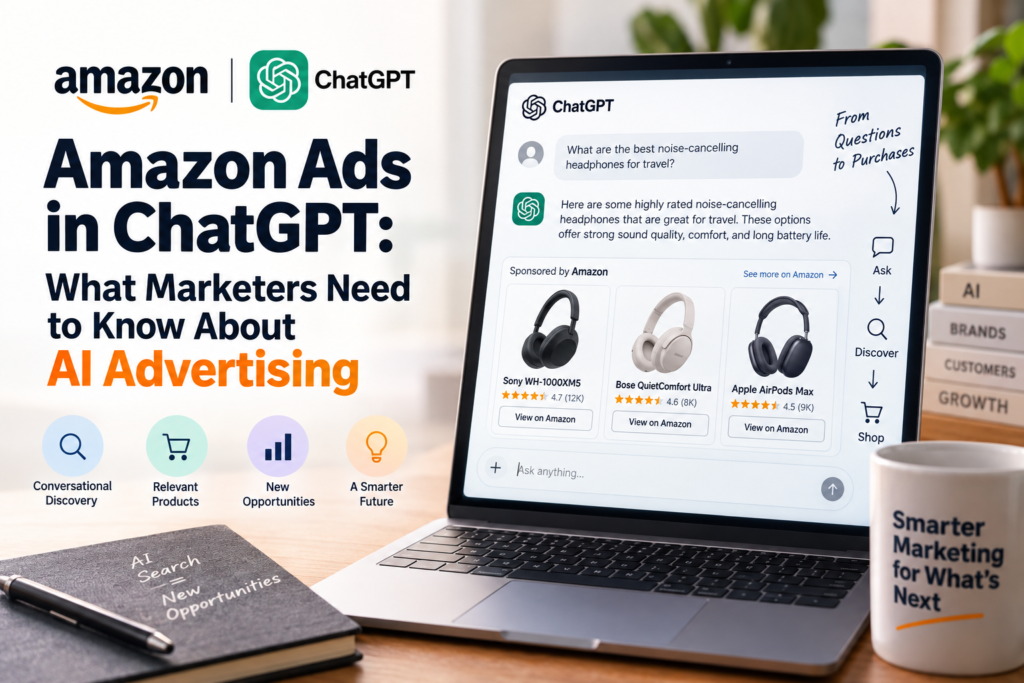
Amazon Ads in ChatGPT: What Marketers Need to Know About AI Advertising
The relationship between online search, shopping, and artificial intelligence is changing rapidly. Amazon Ads in ChatGPT is one example of this shift, with Amazon testing advertising services inside ChatGPT through Amazon DSP. The U.S. pilot includes a select group of advertisers, including Delta Vacations, while OpenAI controls ad delivery and placement.
The development matters because consumers are increasingly using conversational AI to research products, compare options, and make decisions. For context, Amazon’s advertising business generated nearly $70 billion in ad revenue in 2025, while ChatGPT Ads had recently reached a $1 billion annualized revenue run rate, according to Marketing Dive.
This article explores how Amazon Ads in ChatGPT could work, why Amazon is testing the channel, and what Amazon Ads in ChatGPT could mean for marketers as AI-powered product discovery develops. (Resources :https://www.marketingdive.com/)
What Are Amazon Ads in ChatGPT?
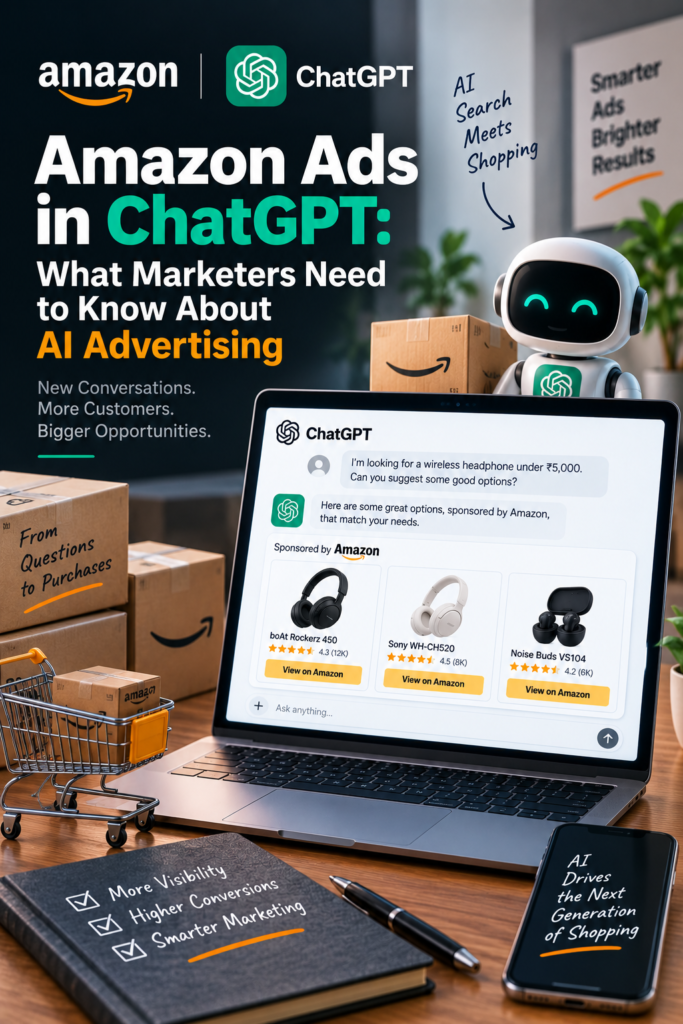
Amazon Ads in ChatGPT refers to a new advertising pilot that lets selected Amazon advertisers extend their campaigns into ChatGPT through Amazon DSP. As reported on September 10, 2026, the pilot is currently limited to the U.S. and is being offered as a managed service rather than as a fully launched, self-serve advertising product. OpenAI controls the ad-delivery decisions through its own systems.
In the current test, Amazon Ads in ChatGPT can appear as text and image ad units beneath organic ChatGPT responses, with clear sponsored labels. Amazon is also testing product-feed ads that can automatically generate creative assets using information from product catalogues. Advertisers can access campaign performance data such as impressions, clicks, CPC, CPM, and cost-per-result metrics.
The important distinction is that Amazon Ads in ChatGPT is not simply another version of traditional Amazon marketplace advertising. Conventional Amazon advertising reaches shoppers within Amazon’s retail and media ecosystem, while ChatGPT placements bring advertising into an AI-powered conversational environment. A user might ask for product ideas or compare options in a conversation rather than type a short keyword into a shopping search box.
For now, Amazon Ads in ChatGPT should be viewed as an early experiment. Its availability, formats, targeting capabilities, and long-term role in digital advertising may change as Amazon and OpenAI evaluate the pilot.
Lets expore this blog with marketingwithaalok
How Could ChatGPT Advertising Work?
The potential of Amazon Ads in ChatGPT comes from combining conversational questions with advertising. Instead of searching for a product using a short keyword, a user might ask ChatGPT for recommendations, compare products, or describe a specific need. In this environment, the conversation provides richer context around what the user is looking for.
During the current pilot, Amazon Ads in ChatGPT can appear as text or image ad units beneath organic ChatGPT responses and are clearly marked as sponsored content. The ads are delivered through Amazon DSP, while OpenAI controls ad placement and delivery through its own systems. Advertisers can buy the inventory on either a cost-per-click (CPC) or cost-per-thousand-impressions (CPM) basis.
For example, someone could ask an AI assistant about products suitable for a particular trip, activity, or shopping need. Relevant sponsored content could then appear alongside the conversational experience. Amazon is also testing product-feed ads that can automatically create advertising assets using information from product catalogues. This could reduce some of the creative work required from advertisers.
The important point is that Amazon Ads in ChatGPT is still a U.S.-only pilot rather than a broadly available advertising product. The current setup gives advertisers aggregated performance information, including impressions, clicks, CPC, CPM, and cost-per-result metrics, but the long-term format and scale of the program have not yet been established.
As the pilot develops, Amazon Ads in ChatGPT could show how advertising works when product discovery happens through conversation instead of a traditional search-results page.
Clarify the pilot’s key takeawayAdd a concise advertiser takeaway
Clarify the pilot’s key takeaway
Add a concise advertiser takeaway
Strengthen the opening with a direct thesis
How Could ChatGPT Advertising Work?
The potential of Amazon Ads in ChatGPT comes from combining conversational questions with advertising. Instead of searching for a product using a short keyword, a user might ask ChatGPT for recommendations, compare products, or describe a specific need. In this environment, the conversation provides richer context around what the user is looking for.
During the current pilot, Amazon Ads in ChatGPT can appear as text or image ad units beneath organic ChatGPT responses and are clearly marked as sponsored content. The ads are delivered through Amazon DSP, while OpenAI controls ad placement and delivery through its own systems. Advertisers can buy the inventory on either a cost-per-click (CPC) or cost-per-thousand-impressions (CPM) basis.
For example, someone could ask an AI assistant about products suitable for a particular trip, activity, or shopping need. Relevant sponsored content could then appear alongside the conversational experience. Amazon is also testing product-feed ads that can automatically create advertising assets using information from product catalogues. This could reduce some of the creative work required from advertisers.
The important point is that Amazon Ads in ChatGPT is still a U.S.-only pilot rather than a broadly available advertising product. The current setup gives advertisers aggregated performance information, including impressions, clicks, CPC, CPM, and cost-per-result metrics, but the long-term format and scale of the program have not yet been established.
As the pilot develops, Amazon Ads in ChatGPT could show how advertising works when product discovery happens through conversation instead of a traditional search-results page.
Why Is Amazon Exploring AI Advertising?
Amazon is exploring AI advertising because product discovery is moving beyond traditional search boxes and into conversational experiences. OpenAI says hundreds of millions of people use ChatGPT to find, understand, and compare products, while its March 2026 shopping update says people are increasingly starting their shopping journeys in ChatGPT.
For Amazon, Amazon Ads in ChatGPT creates a potential way to meet shoppers earlier in that journey. Instead of waiting for someone to search directly on Amazon, Amazon Ads in ChatGPT could reach users while they are still comparing products, asking for recommendations, or defining what they need. That conversational context can make product discovery more intent-driven than a simple keyword search.
There is also a strong business reason behind the move. Amazon has built a large advertising ecosystem around its own shopping and media properties. Amazon Ads says its advertising network reaches an average of 300 million ad-supported users per month in the U.S. across Amazon-owned properties and third-party publishers. By testing Amazon Ads in ChatGPT, Amazon can explore whether its advertising infrastructure can extend into another high-attention digital environment.
The strategy also fits Amazon’s broader investment in AI-powered advertising. Its Amazon DSP already uses AI and large volumes of browsing, streaming, and purchasing signals to optimize campaigns and identify audiences.
For marketers, Amazon Ads in ChatGPT could therefore represent more than another ad placement. It points toward a future where advertising is integrated with conversational product research. However, the current program is still a limited pilot, so marketers should treat Amazon Ads in ChatGPT as an emerging opportunity rather than an established channel
How Could ChatGPT Advertising Work?
The potential of Amazon Ads in ChatGPT comes from combining conversational questions with advertising. Instead of searching for a product using a short keyword, a user might ask ChatGPT for recommendations, compare products, or describe a specific need. In this environment, the conversation provides richer context around what the user is looking for.
During the current pilot, Amazon Ads in ChatGPT can appear as text or image ad units beneath organic ChatGPT responses and are clearly marked as sponsored content. The ads are delivered through Amazon DSP, while OpenAI controls ad placement and delivery through its own systems. Advertisers can buy the inventory on either a cost-per-click (CPC) or cost-per-thousand-impressions (CPM) basis.
For example, someone could ask an AI assistant about products suitable for a particular trip, activity, or shopping need. Relevant sponsored content could then appear alongside the conversational experience. Amazon is also testing product-feed ads that can automatically create advertising assets using information from product catalogues. This could reduce some of the creative work required from advertisers.
The important point is that Amazon Ads in ChatGPT is still a U.S.-only pilot rather than a broadly available advertising product. The current setup gives advertisers aggregated performance information, including impressions, clicks, CPC, CPM, and cost-per-result metrics, but the long-term format and scale of the program have not yet been established.
As the pilot develops, Amazon Ads in ChatGPT could show how advertising works when product discovery happens through conversation instead of a traditional search-results page.
Amazon Ads in ChatGPT introduces a different advertising environment from traditional Amazon campaigns. Traditional Amazon advertising generally captures shoppers within Amazon’s shopping ecosystem, while AI advertising can place commercial messages within a conversational experience where users are asking questions, comparing options, and exploring solutions. Amazon says its DSP uses browsing, shopping, and streaming signals for audience targeting and AI-powered optimization.
| Traditional Amazon Advertising | AI Advertising |
| Keyword and product focused | Intent and context focused |
| Primarily shopping/search environments | Conversational AI environments |
| Sponsored product placements | Potential AI-driven ad placements |
| Product-focused discovery | Question- and problem-focused discovery |
| Captures existing shopping demand | Can influence discovery during research |
With Amazon Ads in ChatGPT, the difference is mainly about where and when the consumer encounters an advertisement. A shopper searching Amazon for “running shoes” may already have a clear product intent. In a conversational AI experience, the same person might ask, “What running shoes should I buy for marathon training?” The second interaction provides more context around the user’s needs.
The current Amazon Ads in ChatGPT pilot reflects this shift toward conversational discovery. Amazon announced on September 10, 2026, that selected U.S. advertisers are testing ChatGPT Ads through Amazon DSP, with OpenAI handling ad placement and delivery. It is still a pilot, not a full replacement for existing Amazon advertising formats.
For marketers, AI advertising therefore should be viewed as an emerging extension of the advertising ecosystem rather than a replacement for traditional campaigns. Amazon Ads in ChatGPT could eventually give brands another way to reach consumers while they are researching and making purchase decisions, but its long-term impact will depend on how the pilot develops and performs.
What Should Marketers Do Now?
The launch of Amazon Ads in ChatGPT is still limited to selected U.S. advertisers, so marketers should not rebuild their entire advertising strategy around it yet. Amazon says the current pilot is designed to let advertisers extend existing Amazon Ads campaigns into a conversational experience through Amazon DSP.
Monitor ChatGPT Advertising Developments
Keep track of how Amazon Ads in ChatGPT develops, particularly changes to availability, ad formats, targeting, measurement, and campaign performance. The current pilot provides advertisers with aggregated metrics such as impressions, clicks, CPC, CPM, and cost-per-result data.
Strengthen Product and Brand Data
AI-powered discovery depends heavily on clear and useful information. Marketers should maintain accurate product details, pricing, features, brand information, and other catalogue data so products can be represented consistently across digital channels.
Improve Product Content
Strong product descriptions, relevant images, clear benefits, and useful supporting content can help consumers understand a product when researching through conversational platforms. This becomes increasingly relevant as Amazon Ads in ChatGPT connects advertising with product discovery rather than relying only on traditional search queries.
Continue Building Amazon Advertising Fundamentals
Businesses should continue working on established Amazon advertising practices, including audience targeting, creative testing, budget management, conversion tracking, and campaign optimization. An emerging AI channel should complement these fundamentals rather than replace them.
Learn How AI Search Works
Marketers should understand how people use conversational AI to discover information, compare products, and evaluate options. Learning this behavior can help businesses prepare for Amazon Ads in ChatGPT and other AI-driven advertising environments.
Test New Channels Carefully
When broader access becomes commercially available, marketers can run controlled tests instead of making large strategic changes immediately. Compare metrics such as clicks, cost per result, conversions, and return on advertising spend against existing campaigns. This evidence-based approach will help determine where Amazon Ads in ChatGPT fits within the wider marketing mix.
What Could AI Advertising Mean for the Future?
The development of Amazon Ads in ChatGPT points toward a broader change in how people discover and evaluate products. Traditional advertising often depends on search queries, keywords, or browsing behavior. AI-powered experiences can add another layer by understanding conversational context and helping users explore products through questions and comparisons. OpenAI says ChatGPT Ads had reached a $1 billion annualized revenue run rate by August 31, 2026, with ads available in more than 40 countries, showing that AI advertising is already moving beyond a small experiment.
More Conversational Shopping
Amazon Ads in ChatGPT could make shopping more conversational. Instead of searching for a product name, users can explain what they need and ask follow-up questions. OpenAI’s current ad system considers conversation context and intent when matching ads, indicating how advertising can become more context-driven.
Greater Importance of Product Data
AI systems need accurate information to understand products and match them with relevant users. Product descriptions, features, pricing, images, and brand information could therefore become increasingly important. For advertisers, maintaining structured and reliable product data may matter as much as traditional keyword optimization.
Changes in Attribution
Amazon Ads in ChatGPT could also create new attribution challenges. A consumer might discover a product in an AI conversation, research it later on Amazon, and complete the purchase somewhere else. Marketers may therefore need to evaluate impressions, clicks, conversions, and the wider customer journey rather than relying on a single touchpoint.
New Advertising Formats
AI can support advertising formats that go beyond static banners or sponsored search listings. OpenAI is already testing Sponsored Agents, allowing users to start a clearly labeled conversation with a business after clicking an ad.
Competition and Transparency
Amazon Ads in ChatGPT also highlights growing competition between AI platforms and traditional search and shopping environments. At the same time, transparency will remain important. OpenAI states that ads are clearly labeled and separated from ChatGPT answers, while advertisers do not receive access to users’ private conversations.
Overall, Amazon Ads in ChatGPT may become part of a wider shift toward conversational commerce, but its long-term impact will depend on user adoption, advertiser performance, measurement, and how AI platforms balance commercial content with user trust.
FAQs About Amazon Ads in ChatGPT
What are Amazon Ads in ChatGPT?
Amazon Ads in ChatGPT refers to Amazon’s partnership with OpenAI that allows selected advertisers to extend campaigns into ChatGPT. The program was announced on September 10, 2026, and is currently being tested by select U.S. advertisers through Amazon DSP. It is a pilot, not a fully open advertising product.
Is Amazon advertising currently available inside ChatGPT?
Yes, but only in a limited pilot. Selected U.S. advertisers can access ChatGPT Ads inventory through Amazon DSP. The ads can appear as text or image units beneath organic ChatGPT responses and are clearly identified as sponsored content.
This means Amazon advertising inside ChatGPT is not currently available to every advertiser or market.
How could ChatGPT advertising work?
ChatGPT advertising places sponsored content within a conversational environment. A user could ask about a product, compare options, or describe a specific need, and relevant advertising may appear alongside the conversation. OpenAI says its systems control ad placement and delivery, while the Amazon pilot is purchased through Amazon DSP.
The goal is to connect advertising with the user’s broader conversational context rather than relying only on traditional keyword searches.
What does AI advertising mean for marketers?
AI advertising refers to advertising delivered or optimized through AI-powered environments. For marketers, this can mean reaching consumers while they are researching, comparing, or discovering products through conversational tools.
Amazon Ads in ChatGPT could make factors such as user intent, product information, creative relevance, and campaign measurement increasingly important. The current pilot provides aggregated reporting such as impressions, clicks, CPC, CPM, and cost-per-result metrics.
Should marketers change their advertising strategy?
Marketers should not replace established campaigns solely because Amazon Ads in ChatGPT is being tested. The pilot is still limited, and its long-term performance and availability are not yet established.
Instead, businesses can continue improving their Amazon advertising fundamentals, monitor ChatGPT advertising developments, and learn how AI advertising may influence product discovery. Testing Amazon Ads in ChatGPT when access becomes commercially available can then be based on measurable results rather than assumptions.
Conclusion
Amazon Ads in ChatGPT represents a potential shift in how consumers discover, research, and compare products through AI-powered conversations. The current pilot is still limited, so it is too early to determine its long-term impact on advertising. However, if conversational shopping continues to grow and ChatGPT advertising expands, AI advertising could become another important channel alongside traditional Amazon advertising.
For marketers, the key is to understand the opportunity without abandoning proven strategies. Monitoring new developments, improving product data, and testing emerging channels when they become widely available can help businesses adapt based on real performance rather than assumptions.
Stay ahead of emerging digital marketing trends with Marketing With Aalok.
Amazon Ads in ChatGPT: What Marketers Need to Know About AI Advertising Read More »
